The law does not say where
The Inheritance Code (ärvdabalken) says how a will must be written and witnessed, but not where it should be kept. There is also no state register where you can record that you have made a will. A prenuptial agreement (äktenskapsförord) must be registered with the Swedish Tax Agency (Skatteverket), but there is no such rule for wills.
In 2025, a government inquiry proposed a voluntary register of wills at the Tax Agency (SOU 2025:91). The proposal is not part of the Inheritance Code today, so storing your will is still your own responsibility. No authority keeps track of the fact that you have made a will, and no one looks for it on behalf of your heirs.
The original is what counts
Your will is the paper document that you and two witnesses have signed. After your death, your heirs must be formally notified of the will with a certified copy, and the will must be included in the estate inventory (bouppteckning) or attached to it as a certified copy. So the person who takes care of the estate needs the original.
Take the original home straight after signing and look after it. If you have destroyed the will, it counts as revoked. Do not write changes by hand on the original either: an addition must be signed and witnessed in the same way as a new will.
What happens after the death
The estate beneficiary (dödsbodelägare) who looks after the property, or an executor if you have appointed one, arranges the estate inventory. It must be carried out no later than three months after the death, unless the Tax Agency extends the time. That is why it helps if the will is found before then.
The heirs must be formally notified of the will, usually by receiving a certified copy. An heir who signs to say they accept the will does not need to be notified. For the others, the time limits for challenging the will or asking for an adjustment start to run from the notification, so anyone who receives something under the will has good reason to make sure all the heirs are notified.
Where can the original be kept?
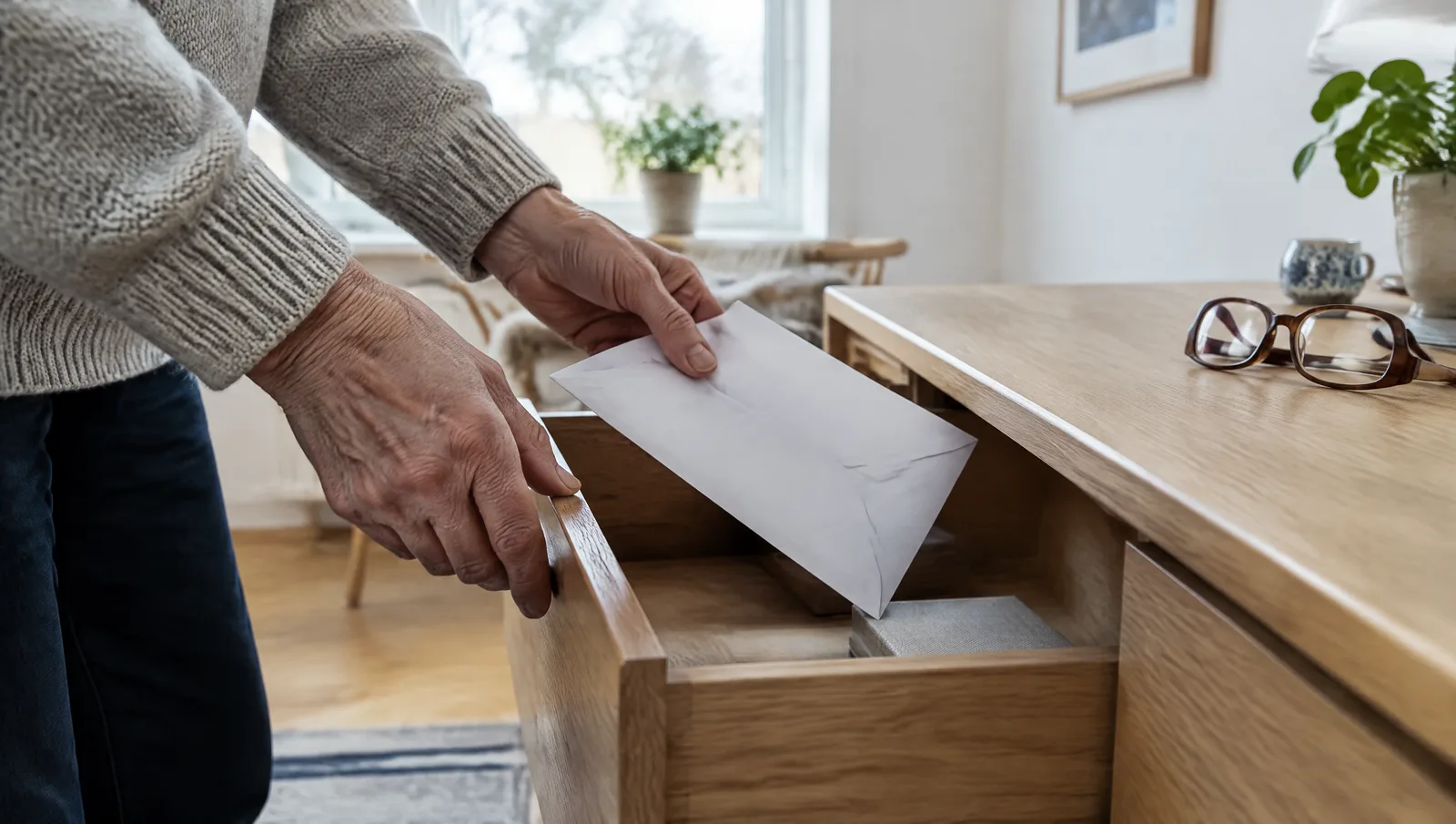
- At home in a locked, fireproof cabinet. This is simple, but the first person to go through your papers may be someone who loses out because of the will.
- In a safe deposit box. Ask the bank how the estate can access the box after your death.
- With one of the witnesses or someone else you trust, ideally a person who neither receives anything under the will nor loses out because of it.
- With a bank or firm that stores wills. Ask what it costs and how they will find out that you have died.
Put the original in an envelope with your name and the word testamente (will) on it, so that it is not thrown away or mixed up with other papers.
Tell someone you trust that the will exists and where the original is, for example the person you have appointed as executor or a close friend. It is a good idea to keep a copy at home, clearly marked as a copy, with a note saying where the original is.
If you write a new will, the old one should not be left lying around. Revoke it in the new will or destroy the old original, so that there are not two versions that could be interpreted differently.
If the will is not found
If no will is found, the inheritance is divided according to the law. Children inherit first, and if you are married your spouse inherits before your joint children. A stepchild or a friend receives nothing, and a cohabiting partner can only ask for a division of property (bodelning) of the shared home and household goods.
If the will turns up later, the person who receives something under it can still claim their right, within ten years of the death. The heirs are notified of the will and then have six months to challenge it or ask for an adjustment to receive their statutory share (laglott).
If only a copy is found, things get more difficult. The law has no rule on what a copy is worth, and since a will that you have destroyed counts as revoked, the heirs can argue that you did it on purpose. A dispute like this may need to be decided in court.
How we can help you
We write your will and give you instructions for signing and witnessing it. We also go through who inherits from you according to the law, so that you know what happens if the will is not found. You keep the original yourself, as we do not store wills. Read more about how we help you write a will, or send an enquiry and you will normally get a quote within one working day.